Techno-Fragility: Japan's Banks Say They May Have to Switch Off for a Month
Hacks, outages, hoax bomb threats and a bank collapse. Why everything suddenly feels like it can break.

On November 9, Nikkei ran an interview with one of the people in charge of protecting Japan's banks from AI-powered hacking. Its headline: "Choosing to stop financial services on purpose: a one-month halt for cyber defence is 'possible.'" Osamu Terai is the group chief information security officer at Mizuho, one of Japan's three megabanks, and he chairs the working group under the Financial Services Agency's council on AI threats to the financial sector.
When the people keeping the banks running say they may have to turn them off, that tells you something. I call it techno-fragility. It's the feeling, more and more common, that any system we depend on can break: the bank, the flight, the email, the payroll, even the grocery store freezer.
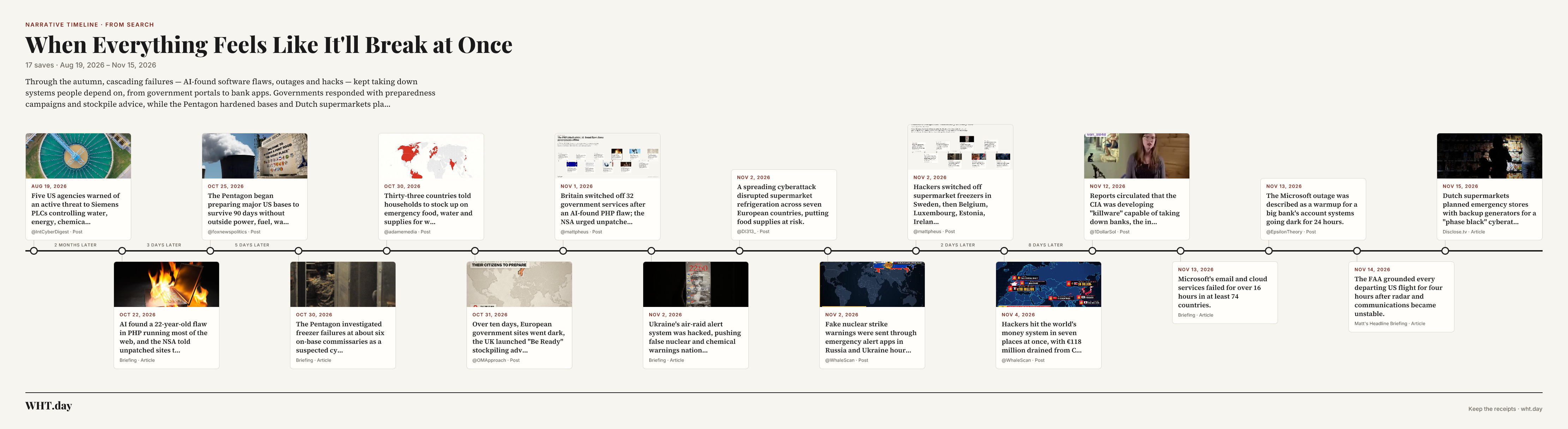
I kept the receipts on these techno-failures as they happened, in WHT.day. One click lined them up on the timeline above, and laid out by date, a month of separate headlines read like one story.
Klaus Schwab saw this coming. In July 2020 he opened Cyber Polygon, a cyber exercise run by the World Economic Forum with Russia's Sberbank and its security firm BI.ZONE. Start at about the four-minute mark:
He said our reliance on digital services and infrastructure “has exponentially increased,” and a few minutes later he warned of
“a comprehensive cyber attack which would bring to a complete halt to the power supply, transportation, hospital services, our society as a whole.”
No single attack has done that. But this fall flights, banks, email and grocery freezers each stopped one at a time, and most of the time nobody had to attack anything.
The Money
Terai has been making this case for weeks. In September he told Toyo Keizai that the old rule, “we will not stop financial services no matter what,” no longer holds. His point is that a bank can either shut itself down for a while to patch a hole, or risk attackers taking its systems down for months.
Three days before that interview ran, the cooperative banks of western Japan, known as shinkin banks and much like American credit unions, stopped working. Starting around 1:30 p.m. on November 6, customers of 128 shinkin banks and about 3,400 branches couldn’t withdraw cash at ATMs, use online banking or transact at the counter. Transfers between banks stopped too. It lasted about five and a half hours. The operators said a piece of equipment failed after a system update in October, not a cyberattack.
Paraguay had it worse. On November 3 the central bank shut Ueno Bank, a fast-growing digital bank, after its solvency ratio fell below half the legal minimum. The app, the cards and the ATMs all stopped that day for close to 3 million customers. The country’s social security institute had more than $500 million there. The owner and directors were jailed, and on November 6 the Senate removed President Santiago Peña by 44 votes to none. Congress passed an emergency law to start paying savers back within 24 hours, and by November 12 all of the roughly 1.8 million insured depositors had received at least part of their money.
And on October 29, North Korean hackers took more than $6 billion from Binance, the world’s biggest crypto exchange, mostly within about 20 minutes. The FBI named North Korea two days later.
Getting Around
On Friday, November 13, the FAA stopped every departing flight in the country for about four hours. Old equipment on its telecom network was flooded with data after a contractor installed a new router at a remote site in Arkansas. The FAA says it has no sign of a cyberattack. About 12,500 flights were cancelled that day. “You will have more of these,” Transportation Secretary Sean Duffy said, “unless the American people and the Congress tell us to build”… meaning give us $50billion!
The same day in New Orleans, the steering on an empty asphalt tanker, the Atlantic Asphalt, failed with its rudder stuck to one side. It hit the American Heritage, a river cruise boat tied up at the dock, and the riverboat rolled over in about 22 minutes. Nobody died, though 32 of the roughly 190 people aboard went to the hospital.
In Europe the problem was fake threats. From November 2 to 6, emailed bomb threats hit passenger flights across the continent, at least 34 of them that week by the Guardian’s count. Fighter jets escorted airliners into Rome and Sofia. No bomb was found. On November 11 the same kind of email reached about 6,300 Italian schools, and around 300 were evacuated.
The Everyday Systems
On November 12, Microsoft’s Outlook, Teams and the rest of Microsoft 365 failed worldwide for about a day. Microsoft said the cause was “not related to cyber or AI” and traced it to an earlier upgrade of its own network.
Even the food. On October 12, attackers sent refrigerator temperatures soaring at about 700 French supermarkets, and France later blamed Iran. On the night of November 1, it happened again in Belgium, Ireland, Sweden and several other countries. “It’s a cyber-attack, there is no other reason,” a Carrefour spokesman said. In the US, the Pentagon is treating freezer failures at six base commissaries as a suspected hack, still unconfirmed.
The Builders Are Worried Too
The people building AI are saying out loud that they can’t keep up. At Stanford on October 21, OpenAI’s Sam Altman said AI models can find “crazy bugs” outside the normal threat model, and then: “I no longer think we’re going to be able to just patch all the bugs.” Two days later Cloudflare’s CEO Matthew Prince told Reuters, “I think we’re going to have a couple years where every single week it’s going to feel like the sky is falling.”
That’s the fragility half. The futility half is work. On October 26 Microsoft offered voluntary buyouts to about 60,000 employees, roughly a quarter of its staff. In September Gallup found a record 27% of American workers worried that technology could make their jobs obsolete. The layoffs haven’t caught up with the fear. In October employers cited AI for about 1,300 job cuts, the lowest month of the year, according to Challenger, Gray & Christmas. People aren’t reacting to their own pink slips. They’re reacting to what they see coming.
In my last issue I wrote about the 16 governments and the EU that told households this fall to keep at least three days of supplies (https://www.smithsense.com/p/the-pentagon-is-planning-for-90-days). A lot of the reasons they gave were these very systems. Britain’s “Be Ready” campaign lists cyberattacks and phone and broadband outages as hazards. Luxembourg’s guide covers everything from natural disasters to cyberattacks. Norway raised its cyber threat level on October 29 and told people to be ready to manage without power and water for up to a week. The prefecture in Normandy put cyberattacks on its list too.
Why It Feels This Way
Here’s what I noticed when I laid the receipts out by date. Most of the breaks weren’t attacks. The FAA, Microsoft, the Japanese banks and the tanker on the Mississippi came down to old equipment, an upgrade gone wrong, a failed part or a stuck rudder. The attacks that did happen were often cheap: an email that grounds a plane costs nothing to send. Ueno wasn’t hacked at all. It ran out of capital.
You’d think that would make people feel better. It doesn’t. If nobody has to attack a system for it to fail, there’s no enemy to defeat and no fix to wait for. Everything now runs through a few shared systems, so one router problem stops departures across the whole country and one equipment failure shuts ATMs across western Japan. When something breaks, it breaks for everyone at once, and it’s on everyone’s phone within the hour. People see that again and again, and they draw a conclusion. That’s techno-fragility. I don’t think it’s paranoia. I think it’s people paying attention.
What to Do
Act as if the systems you rely on will be down for a while, because their own operators are telling you they might be. Terai’s own advice, as reported in Nikkei, was to spread your money across more than one bank. I’d add some cash at home, a credit card on a different network, and copies of your important records that don’t depend on any one login.
Why I Keep the Receipts and Maybe You Should too…
I like keeping the receipts because things get lost: posts get deleted and articles get quietly edited. If you didn’t keep the receipts, then instead of the original you’re left with spotty memory and whatever the feed still shows you.
That’s why I built WHT.day. When you save an article, an X post or a video, it keeps your own dated copy: the full text, the photos and video, the source and the original link, filed on the day you saved it.
If the original is deleted, edited or put behind a paywall, your copy stays readable. Clip any page with the browser extension or connect X once and it brings in your 800 most recent bookmarks and picks up new ones three times a day.
What should you save? Anything that strikes you as outrageous, unbelievable or big enough that it might matter later. Then open any save and press Build timeline, and WHT.day lines up the related receipts by date with a link to every original, like the timeline at the top of this post. Your archive is private, and even if you cancel, you keep access to every receipt you saved.
It’s good to have the receipts
Use code [THISWEEK1115] for 15% off your first year through Friday, Nov 20.
Try WHT.day today by clicking here
I’m sure it’ll be another interesting week!
Matt
The new “bank holiday”
Your software program you've invented using AI is very good and useful. I will buy it later.
The fragility of today's ultra-centralized system, due to technology and equipment failures and/or to purposeful attacks, is hazardous. Why worry about incoming 'nukes'? They can just attack the centralized system, such as the electrical grid. I think this is real.