

NATO’s chief said resilience means “preparing individuals for whatever might come our way.” Within weeks, governments on three continents told their people to get ready. Since NATO published its civil resilience requirements on Sept 15, 16 national governments and the EU have told households to prepare for emergencies, each giving a different reason or none at all, and my read is that the reasons are local paint on one shared ask.
The last time governments everywhere said the same thing at the same moment was 2020. During COVID, virtually every country on Earth was singing from the same song sheet. This fall feels the same to me.
The Memo
On Sept 15, NATO published its Resilience Baseline Requirements for the first time. It’s what every ally must have ready for “peace, crisis and conflict,” and it calls for “a whole-of-government and whole-of-society approach.” It asks for “a comprehensive system of national capabilities for civil protection/civil defence that is resilience-based and preparedness driven,” and for alert systems that reach “the civil population.” The next day, NATO’s resilience directors met the European Commission to talk about the EU’s own preparedness strategy.
A few days later NATO released a brochure on the requirements with a foreword from Secretary General Mark Rutte. The line that matters: “Resilience also fortifies communities, preparing individuals for whatever might come our way.”
NATO’s text never mentions household kits or 72 hours, and the groundwork is older. The EU set the 72-hour target in its March 2025 strategy, and Britain announced its campaign plan in July. The plans existed. My case is that NATO’s memo is when the notices started landing.
What Happened Next
I counted only national governments telling households to prepare, and dated each notice. Sixteen did it after Sept 15, plus the EU.
On Sept 21, Ireland began mailing an emergency booklet to 2.2 million homes, and Sweden opened its preparedness week. On Oct 1, Belgium published a guide with a 72-hour kit, citing power cuts, floods and fires. On Oct 9, Luxembourg’s prime minister presented “My Guide to 72 Hours of Self-Sufficiency,” for anything from natural disasters to cyberattacks. On Oct 12, the Netherlands relaunched its campaign and Uruguay asked every home to keep a 72-hour bag, aimed at flood zones.
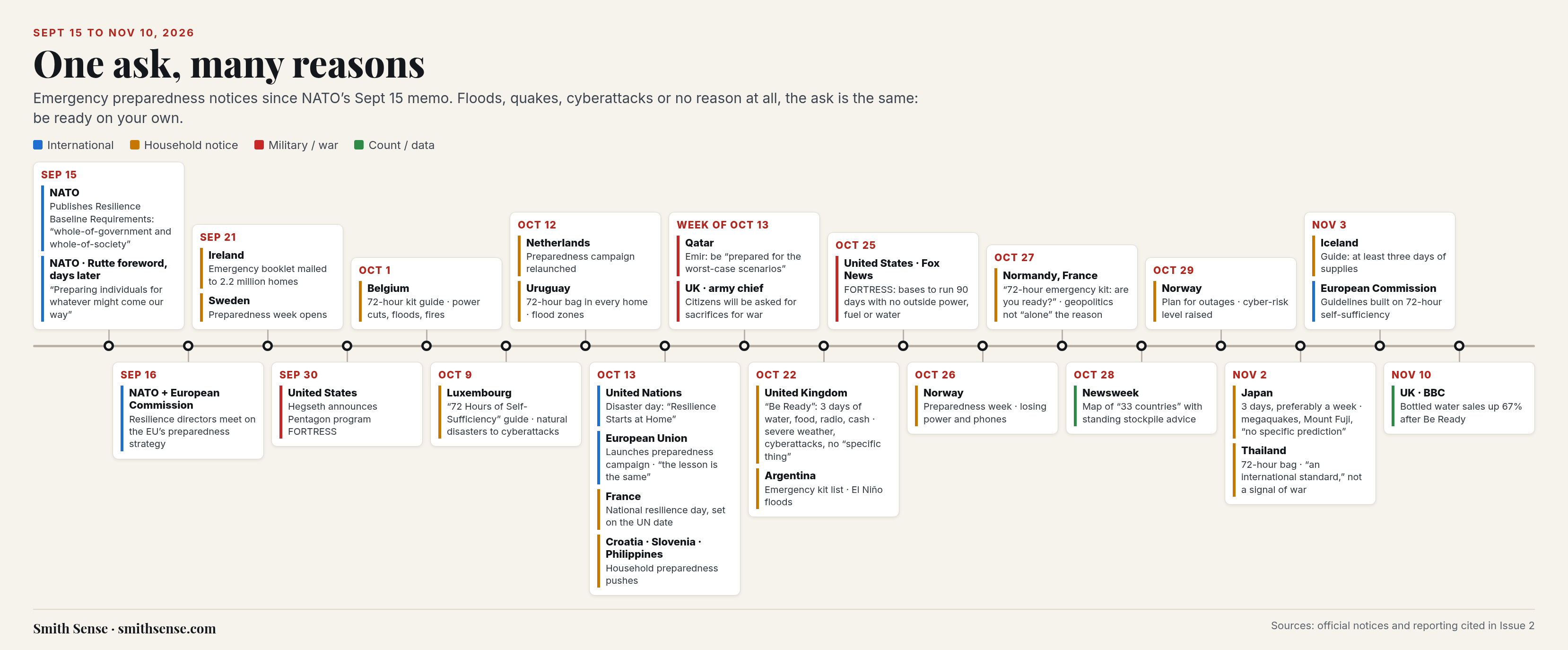
Oct 13 was the UN’s disaster day, themed “Resilience Starts at Home.” The EU launched a campaign, France held its national resilience day, which it schedules on the UN date on purpose, and Croatia, Slovenia and the Philippines pushed household preparedness. That week Qatar’s emir said to be “prepared for the worst-case scenarios” and Britain’s army chief said citizens would be asked for sacrifices for war. I saved both, but neither asked for supplies, so I didn’t count them.
On Oct 22, Britain launched “Be Ready”: three days of water, food that needs no cooking, a torch, a radio and cash. The named threats were severe weather and cyberattacks, but Defence Secretary Wes Streeting said there wasn’t a “specific thing” in mind. “We looked around the rest of Europe,” he said. I saved the launch. The same day, Argentina published a kit list, citing El Niño floods. Norway opened its preparedness week Oct 26, on losing power and phones. On Oct 27, Normandy’s prefect posted “72-hour emergency kit: are you ready?” and said geopolitics “alone” wasn’t the reason. I saved that too. On Oct 29, Norway told people to plan for outages after raising its cyber-risk level.
On Nov 2, Japan’s new disaster agency issued an “emergency request” for at least three days of supplies, preferably a week, citing megaquakes and Mount Fuji, and its minister later said no specific prediction was behind it. Thailand told households to pack a 72-hour bag the same day, called it “an international standard,” and said it wasn’t a signal of war. On Nov 3, Iceland published a guide asking for at least three days and the European Commission published guidelines built on 72 hours. I saved the Japanese, Thai and EU notices. By Nov 10, British bottled water sales were up 67%, the BBC reported.
The “33 countries” figure going around comes from an Oct 28 Newsweek map of standing advice, which left out Belgium and Luxembourg. By my count, 47 countries now have national advice to keep three days of supplies or more, including 22 of the EU’s 27.
Different Reasons, Same Ask… Get ready.
In 2020 the reason was one virus. This time it’s floods in Uruguay, earthquakes in Japan, cyberattacks in Britain and Norway, and from Brussels nothing more specific than crises getting “more frequent and complex.” And yet the ask is the same, right down to the water ration and the cash.
“The COVID pandemic has shown that the added value of acting together in solidarity, in coordination... is absolutely crucial.” - EU Commission VP
That’s by design. The 2024 Niinistö report that shaped the EU strategy wants households ready “regardless of the emergency.” Rutte’s “whatever might come” says the same thing. The campaigns then cite each other. Britain says its three days copies France, Ireland and the Netherlands. Belgium says the figure “comes from a European recommendation.” On Oct 13 the EU’s preparedness commissioner, standing with the UN’s disaster chief, said: “The fires, floods, earthquakes, and hurricanes we face may be different. But the lesson is the same.” At the EU strategy launch, Commission Vice-President Roxana Mînzatu said “The COVID pandemic has shown that the added value of acting together in solidarity, in coordination... is absolutely crucial.” They told us where the playbook came from.
What Comes Next?
This is my read, not a forecast, and I could be wrong.
The 72-hour number is a floor. Japan and Sweden already ask for a week. Advice is also turning into bureaucracy. Japan will review progress at year-end and can push budget changes, and the EU wants preparedness taught in primary school. A requirement usually follows.
Cash is back in the official script. Sweden’s central bank says keep about 1,000 krona per adult. The Dutch central bank says €70 per adult for the first 72 hours, in the same strategy that promotes the digital euro.
And the burden is shifting to you. Japan’s message is literally “protect your own life yourself.” Britain says your preparation “reduces the strain on our emergency services.” The state is taking care of the state. The first three days are yours.
The Pentagon is doing the same thing for itself. On Sept 30, two weeks after NATO’s memo, Pete Hegseth announced a program called FORTRESS, and on Oct 25 Fox News reported from internal documents that it calls for U.S. military bases to run for 90 days with no outside power, fuel or water. Bases are being built to last three months on their own, and households are being told to manage three days.
What My Archive Showed
No single headline showed me this. I’d been saving these as they came in, and when I laid them out by date in my WHT.day archive, the clustering jumped out. It also kept a viral post claiming Australia told people to stockpile, which AFP showed was false.
Not everyone has the urge to archive. I do, and COVID is why. During those years the news came at us every day, wild enough that you assumed you’d never forget it. Looking back now, a lot of it already feels unreal. Some of it got memory-holed. Some of it got rewritten. If you didn’t keep the original, you’re stuck with whatever the feed still shows. When governments started speaking in one voice again this fall, I wanted the originals this time.
That’s what WHT.day is for. You save news, tweets and articles into a personal, private archive while they’re still in front of you, before they become a half-remembered headline you can’t prove. Full text, filed on the day you saved it, kept for you forever.
Saving is easy. Connect X and your bookmarks come in on their own. Use the browser extension on any article or page. Or import what you’ve already saved elsewhere. What belongs in it? Anything that stands out as outrageous, unbelievable, or big enough that it might matter later, and anything you think you might want to come back to. The search inside WHT.day is smart enough to find it again, so you don’t have to worry about over-saving.
One click on any save pulls the related pieces from your archive onto a dated timeline. Do that on any one of my preparedness saves and Qatar, Britain, Normandy, Japan, Thailand and the EU line up behind it in date order.
If you subscribe and later cancel, you stop adding new items. Your archive stays, and you keep access to everything you already saved.
WHT.day is $8 a month or $68 a year. This week’s code, THISWEEK1115, takes 15% off your first year through Friday, Nov 20:
Start your own personal, private archive today: Click Here
What to Do
What concerns me isn’t any one of these notices. Each one, taken alone, is sensible advice. It’s the coordination. We haven’t seen governments around the world move in step like this since COVID, and back then the synchronized messaging came right before the rules changed for everyone. It makes me wonder whether the powers that be know something the rest of us don’t. I don’t know. Nobody has said, and maybe there’s nothing to say. But when this many governments tell you the same thing in the same few weeks without telling you why, I’d rather be ready than find out.
I also think 72 hours is nowhere near enough. Three days is how long officials figure it may take help to reach you, not how long it takes for life to get back to normal. The better yardstick is the one the U.S. military is reportedly using for itself. If the Pentagon thinks its bases need to stand on their own for 90 days, your family should too.
Ninety days sounds like a lot, so build it in layers. Get to two weeks first, then a month, then three. Store food you already eat and rotate it, so nothing goes to waste. FEMA’s rule of thumb is a gallon of water per person per day, which is a lot of jugs at 90 days, so add a good filter and a way to collect water. Ask your doctor about 90-day refills for any prescriptions. Keep cash in small bills, a battery or hand-crank radio, light, and some way to make power if the grid goes down. Buy gradually while the shelves are full and prices are normal, and don’t wait for a reason to be announced. Whatever it turns out to be where you live, the first days will be on you, and possibly a lot more than three.
Best,
Matt Smith
Great Work Matt!!!
It's almost as if, for example, perhaps the Jacobins and Bolsheviks in power in some European bankrupt welfare states in serious economic decline from green theocracy, including the UK and those desperate to make NATO purposeful again are thinking about the worlds oldest and most destructive distraction in re-enacting the failures of Napoleon and Hitler, including Victoria Nuland's ongoing failed 2014 attempt at re-enacting the Crimean war. If so, it's as if none of them have any memory or knowledge of those of us who lived through the cold war and the insanity of existential threats to nuclear powers.