

To all of those that think AI = Slop or don’t see a need to learn to use the tools...
I spent much of last two days working with AI. I know it’s the future, and I’ve watched it evolve, but frankly I’ve fallen behind. It’s advancing so quickly - and its capabilities are expanding so fast - that I can feel myself losing ground.
I’m not a techie. I don’t code, and I still can’t get Claude Code set up properly - yet - though I will. In the meantime, here’s what I managed to pull off mostly over a single Saturday while balancing everything else:
What I Built in a Weekend
Dashboard Development
I built a dashboard that pulls together multiple lines of business. I can now see, in real time, how many customers I have, the net revenue they generate, trends over time, and what those customers are actually worth.
When I ran a company with 200 employees and a 40-person tech group, it would have taken two or three months to get this kind of dashboard shipped. With AI, it took about eight hours total.
During those eight hours, I went back and forth between the AI and the rest of my work. I’d give it a task, it would do the work and come back with questions or results, and then I’d test it, give feedback, and send it back out again. Once it created a solid base, it suggested improvements. Not every suggestion was a winner, but plenty were, and I added those too.
For the first time, I have a clear dashboard showing exactly how the business is performing compared to the past. And I got it without a single employee, a technology expert, or expensive software subscription costs.
Membership Site Exploration
I dabbled with creating a new membership site for Phyle subscribers.
I made real progress - it looks good and it works - but I wasn’t sure how to move people over cleanly, so I’ve paused it for now. The transition has lots of edge cases, but I have no doubt AI will simplify most of them. So it isn’t live yet, but it absolutely could be, and I expect it will be.
Saving Money
On Lark, I uploaded my American Express bill for all of 2025. I asked it to show me where I’m spending all this money and what I can change. I told it to focus on recurring charges — things I’m not using, things I should downgrade, or subscriptions I should just cancel.
Within 60 minutes, I’d reduced annual recurring charges by about $7,000.
Business Improvements
On the business-improvement side, I wanted to know what obvious things I might be missing with my Substack newsletter (CrisisInvesting.com). I asked AI to evaluate whether I’m actually using the Substack platform the way it’s meant to be used. Specifically, I asked:
Was I taking advantage of all the available features?
Was I fully leveraging our YouTube channel?
Were there other opportunities I was missing?
Ultimately, I was looking for low-hanging fruit — the easy stuff I should have done months ago.
AI generated several ideas — some I could implement immediately, and did. Within an hour of implementing one of them, it had already resulted in five additional paid subscribers. This, in addition to the other work I’ve been doing to grow the business recently, pushed us all the way up to #6 in Finance Rising Stars.
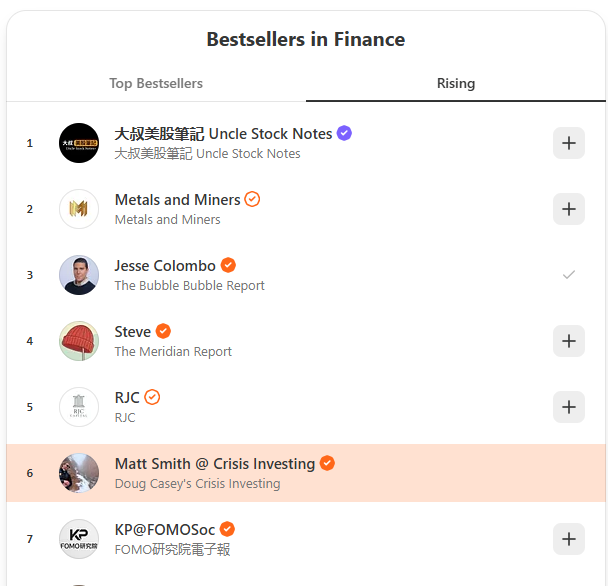
AI doesn’t just hand you suggestions. If you keep going, it can help you deploy them. Sure, there’s still some manual work. But the heavy lifting? AI did that.
Back in 2009, when ZeroHedge was just getting off the ground, I had a relationship with someone there. Every single article I published was syndicated by ZeroHedge, which was a huge benefit to our business at the time. Today, from time to time, our articles get republished elsewhere and eventually end up on sites like ZeroHedge. I reached out to get our CrisisInvesting.com articles regularly syndicated, but my contact is no longer there. My emails go unanswered.
So I asked AI, “How do I get back into the distribution system?”
It gave me some ideas and helped me draft a compelling case for why we should be added as a contributor. For the record, as always with AI writing, there was an enormous amount of editing and changes required to make it sound like me and to make it accurate. But again, fundamentally, it did the heavy lifting. Writing that email is something I put off for years; with AI, it was no big deal.
Will it get us back on ZeroHedge? Who knows. The email is scheduled to go out on Monday morning, so we’ll see how it goes.
And in case you’re wondering: no, this missive is not written by AI - not even a single word of it. However, I do use an AI tool on my computer that converts my voice to text, so this note is essentially dictated, with an AI interface in between.
I use the voice to text AI constantly to respond to text messages, draft emails, and write essays. It’s a huge productivity enhancement for me.
How to Get Real Value Out of AI
The key to making all of this work is prompting — and practicing it. You have to learn how to write a good prompt, which mostly means giving the AI enough context to produce real solutions instead of superficial suggestions. Once you get those suggestions, don’t stop there; ask it to help you implement them and handle the heavy lifting. You can even set up daily tasks. For example, I use AI to monitor for local events in my area — things my family and I might want to participate in — and I get alerted every week.
AI is the biggest boon for entrepreneurs I have ever experienced in my entire life, and nothing even comes close. The implications of all this are even more impressive (or disconcerting, depending upon your point of view).
I try to stay generally up to date with AI’s capabilities, but I’m nowhere near using these tools to their full potential. Right now, there are thousands — probably hundreds of thousands — of people devoting enormous time and energy to turning AI into a personal superpower. Used well, it lets one person do the work of dozens, if not hundreds, of people.
If you’re an employee and you aren’t using these tools to do your work better, you’re making a gigantic mistake. Sooner or later, you’ll be replaced by someone who does. I don’t think AI will replace you directly, but someone who knows how to use it certainly will.
And that one person might not replace just you; they could probably replace a dozen of your coworkers. That’s how good these tools are when you know how to use them.
Most People Are Using It Wrong
Most people use AI to create “AI slop” — trash or stuff nobody wants to read, like the low-quality writing that’s filling our feeds. Or they use it as an advanced form of Google for research or to get basic information.
The proper way to use AI is to have an actual problem and leverage AI tools to solve it. Like with the reporting dashboard I made. I was frustrated with not having great access to business intelligence that I’d always had in my past entrepreneurial and business endeavors.
Any specific, well-defined problem is a perfect task for AI.
A Few More Projects I’ve Built
I own many thousands of books - some in digital print form and some in audio-digital form. One day as a project, I created a much better interface for my digital audiobooks than I can get from Audible alone.
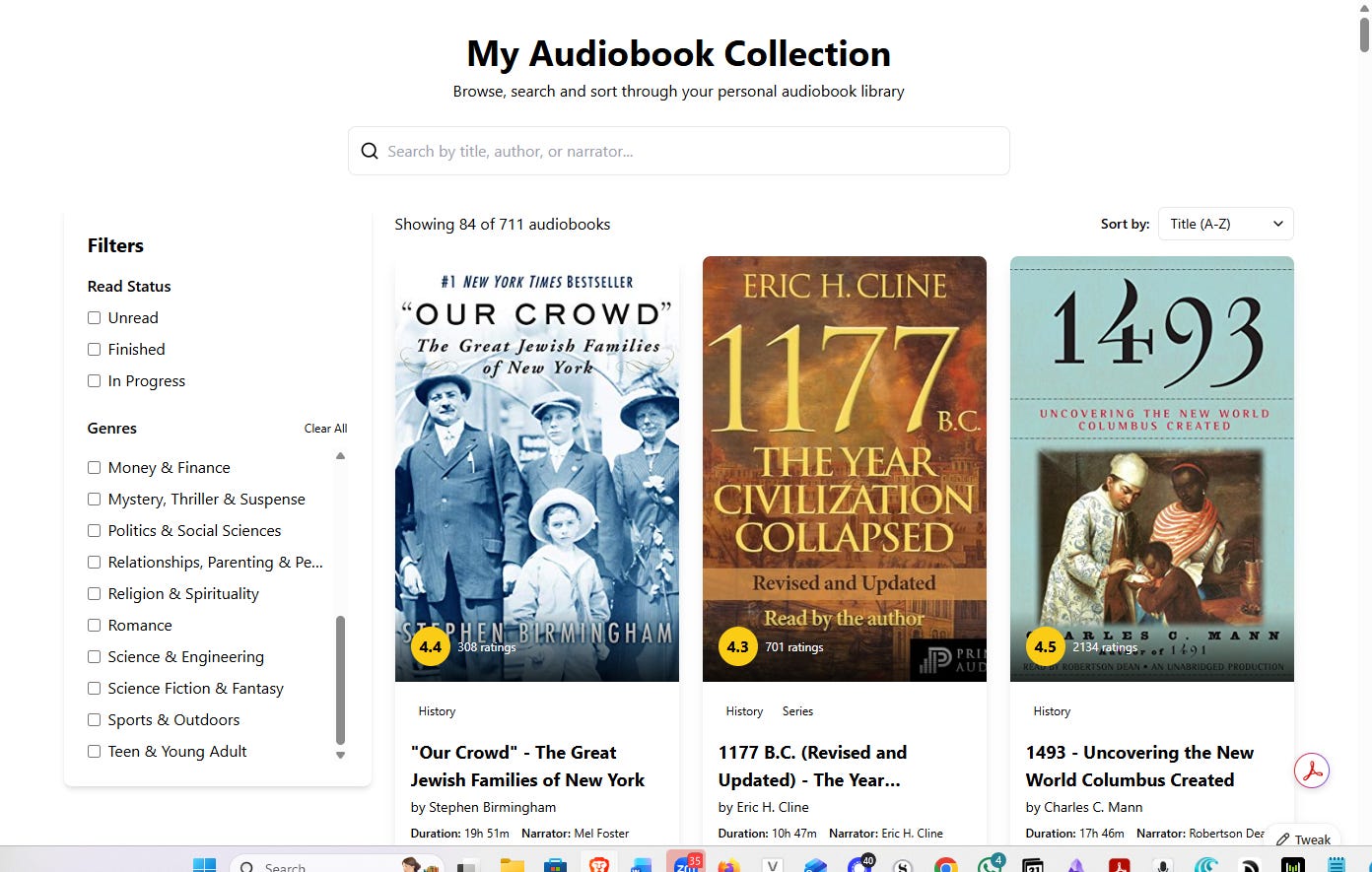
It allows me to search by topic and content through the 717 books in the library to find the one I want. When I click on it, it opens Audible.
I created another book directory while I was writing the book with Doug Casey called The Preparation. I assembled all our book recommendations into a single website so that I could see what was included, what was required, and what was optional for reading.
You can check out that website here if you’re curious:
For my wife’s birthday, I built an application using AI that took in photographs of her throughout her life and turned them into a beautiful video with music - specifically designed to tug at her heartstrings.
It took me about 20 hours to get this project done. It wasn’t easy, but it was part of my experiments to make sure I actually understand how these tools work. The upshot is that it did, in fact, make her cry. She loved it.
Three Takeaways
Why do I share all this? For three reasons:
1. A warning: If you’re not using AI to build things, create things, and productively add to the world - if you don’t know how to use these tools to accomplish that - you will quickly fall behind, and there will be consequences and missed opportunities.
2. Missed opportunities: Whether it’s saving $7,000 on recurring charges I didn’t need (and no doubt you have some of those on your credit card too), using AI to do any part of your work better, or building things where you’re limited only by your imagination - you’re leaving a lot on the table.
3. Macro consequences: These are hard to fathom. You hear lots of talk about an “AI bubble,” and sure, there may be over-investment in data centers. But the productivity unlocked by these tools is difficult to wrap your head around. They will change the world. They will change the way you work. They may even determine whether or not you work.
Even more, they’re just getting started. The technology is improving so rapidly that it’s impossible to keep up with, and (even more) people are still learning how to leverage these tools fully.
Like I said, there are thousands - maybe hundreds of thousands - of people devoting enormous amounts of energy to mastering these tools. Will they be able to do things with them that we cannot currently imagine? Yes. And that’s just with the current tech; the technology in six months will be much better.
As you might have heard me say before, what we’re experiencing with AI today is akin to the Industrial Revolution experienced in America after 1880. It totally destabilized civilization. Careers that were thought secure vanished, and new jobs emerged. New fields emerged, new art emerged, and the world was better for it. But the process was tumultuous and difficult for those who were not prepared.
So, if you’re already experimenting with AI, congratulations. I encourage you - as I do myself - to double down on your experiments and building your skill set.
For those of you who think it’s a passing fad, or that you’re too old to take advantage of these technologies, you’re making a gigantic mistake. There is so much more that can be done with them; there is much to be learned and created, and there’s no reason that you should be excluded from all of that creation. Simply ignoring it will have severe consequences and plenty of missed opportunities.
Best,
Matt