

I save interesting and incredible posts and articles everyday through my WHT.day browser extension. When I lined up the 14 I’d saved on prices between August 27 and October 28, they didn’t read like separate stories. They read like a patient’s chart, and every entry is worse than the one before it. The timeline below lays them out in order.
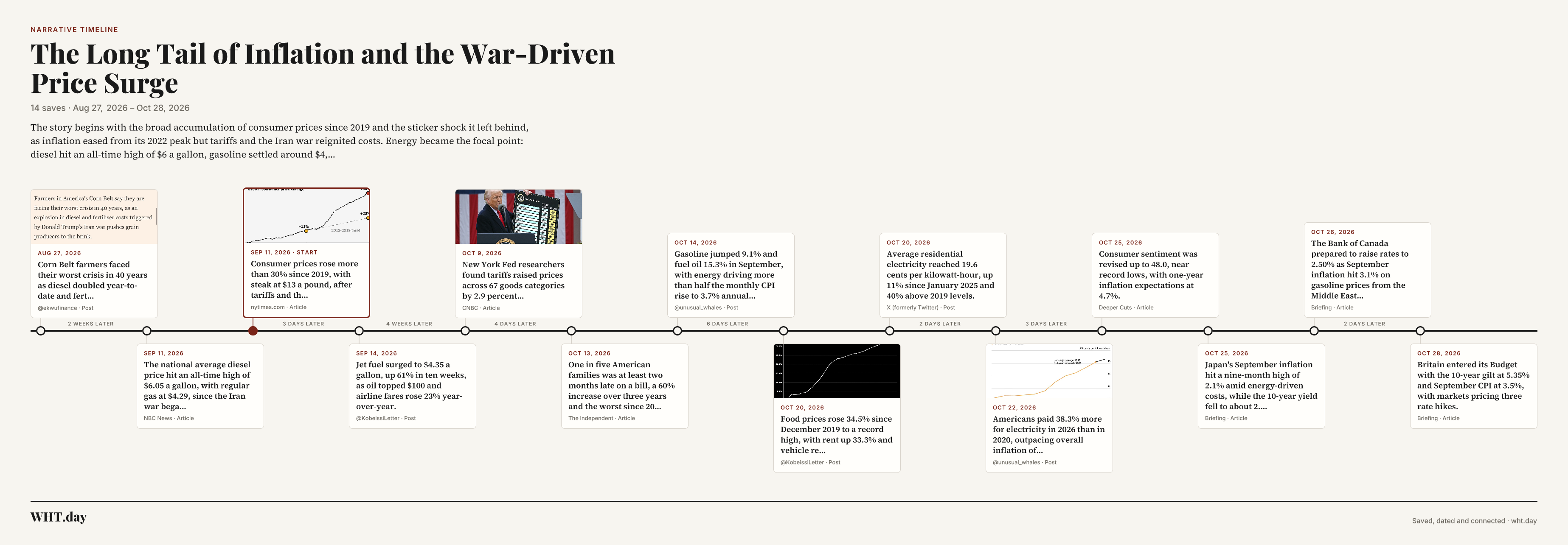
Here’s what it shows. The war with Iran started as a fuel shock. Over two months the higher cost spread from diesel into food, flights, electricity and rent. By the end of October families were falling behind and central banks were raising rates into weak economies. Nothing on the timeline gets better.
Late August: the farms
The first entry is from August 27. US Corn Belt farmers were facing their worst crisis in 40 years. Diesel had roughly doubled this year, and fertilizer doubled during planting season. The Corn Belt grows about 80% of America’s corn, so that cost doesn’t stay on the farm.
September: diesel and jet fuel break records
Two weeks later, on September 11, diesel hit $6.05 a gallon, the highest ever, per AAA. It was up 60% since the war began in late February. Regular gas was $4.29.
Why does diesel matter so much? Because it moves everything else. “The cost of diesel gets into just about everything,” KPMG chief economist Diane Swonk told NBC News, and she expects it to be an “inflationary problem” for months. Mark Mueller, a fourth-generation Iowa farmer who chairs the Iowa Corn Growers Association, said $6 diesel will “push me right to the edge.”
The same day the New York Times laid out how much damage was already done before the war. In 2012 a pound of steak cost about $6. By 2019 it was about $8. Today it’s $13. Overall prices are up more than 30% since the start of 2019. Inflation had nearly gotten back to normal, at 2.3% in April 2025. Then came the tariffs, and just as those were fading, the war.
Three days after that, jet fuel hit $4.35 a gallon, up 61% in ten weeks, with oil above $100 a barrel. Airfares in August were up 23% from a year earlier.
Early October: it spreads to everything
On October 9 New York Fed researchers put a number on the tariffs. Prices on 67 kinds of goods were about 3 points higher because of them, and the researchers expect people to keep paying for that into 2027. So the war’s price surge landed on top of a price increase that was still working its way through.
Four days later came the worst entry on the timeline. The Federal Reserve’s survey of about 4,400 families found the share behind on a loan payment jumped from about 12% in 2022 to almost 20% in 2025. That’s one household in five. The last time it was this bad was 2008, when unemployment was twice what it is now. And that survey was taken before the war started.
The same article has the simplest explanation I’ve seen. Since September 2016 the cost of living is up 39%, according to federal data, and median household income is up 13%. Put it in dollars. For every $100 your life cost in 2016, it now costs about $139. For every $100 you earned, you now earn $113.
On October 14 the fuel shock became the inflation number. Gasoline jumped 9% in September and fuel oil, which includes diesel, 15%. Energy made up more than half of the month’s rise in consumer prices, and annual inflation officially came in at 3.7%. In July it had officially been 3.4%.
Late October: the bills you can’t skip
On October 20 food prices were reported at a record, up about a third since the end of 2019. Rent is up about a third too, and car repair is up 55%. The same day, the average home’s electricity was reported at 19.6 cents a kilowatt-hour in August, near an all-time high and 40% above 2019. Two days later Bloomberg’s count had Americans paying 38% more for electricity than in 2020, while overall prices rose about 29%.
Can you skip groceries, rent or the power bill? No. That’s what makes this stage worse than a spike at the pump, because you can drive less when gas jumps but you can’t put off meals or the rent for long.
People feel it. On October 25 consumer sentiment came in at 48, close to the all-time low of 45 set in May. Americans now expect almost 5% inflation over the next year.
The end of October: central banks can’t pump oil
The last entries show the same squeeze abroad. Japan’s inflation hit a nine-month high. Canada’s rose to 3.1% in September on gasoline, and its central bank was expected to raise rates even though the country lost 68,000 jobs that month. Britain’s inflation came in at 3.5%, and markets expect three rate hikes by April.
Will higher rates fix this? Not the part that matters. As one of the briefings I saved put it, “Rate hikes cannot produce a barrel of oil. They can only make people poorer until they use less of it.” So the response to a fuel shock is to slow economies that are already losing jobs.
I built WHT.day so that we could all keep a personal archive of the important articles, tweets, etc we stumble upon rather than letting them be lost to history. The tool allows you to keep a permanent archive forever. It also allows you to see how related events stack on top of each other and create trends like the one above. If you’re a news junkie like me and want your own personal archive of the important, bizarre, or unbelievable stories you read, get started at wht.day before they’re memory-holed.
Why it doesn’t reverse
Officially, inflation has come down a long way from its 9% peak in 2022. But a lower inflation rate only means prices are rising more slowly. Think of a car that slows from 90 miles an hour to 30. It’s still moving forward. It isn’t driving back to where it started.
Diesel shows how this works. It set its last record in June 2022, at $5.82, after Russia invaded Ukraine. It fell some after that, but it never got back to where it was before 2022. Then it set a new record this September. Each shock lifts the floor, and the next one starts from higher up.
The Times says the sticker shock fades only after years of normal inflation, the way nobody expects a Coke to cost a nickel anymore. We don’t have normal inflation. We have a war that’s still going and prices that were already a third higher before it started. Steak isn’t going back to $8.
So look at your own budget the way this timeline looks at the country. Which costs are tied to fuel and power, and how much room do you have if they climb again? Pay down the expensive debt first, and build the cushion while you can.
Source: wht.day